
AI made your agency faster. Who kept the saving?
It’s now almost four years since ChatGPT launched and the agency world began taking AI seriously. New data shows how far that has gone: 81% of agencies have at least settled on shared tools and ways of working, and plenty have gone deeper, adding real value to the work delivered. In many cases, though, the agencies seem to be the only party not capturing that value. Clients are getting more work for the money, the AI companies are certainly doing well from it, but only 21% of agencies have consciously turned any of it into margin.
The data comes from my own Agency Loop quarterly survey that goes to a panel of over 200 agencies, with the aim of surfacing insights like this for those who take part. This quarter we returned to AI adoption as a topic. The full results and analysis are shared freely with those who contribute and with a few interested third parties (contact me for details). This article looks at one specific tension in this quarter’s data, around how agencies are and aren’t pricing to reflect the involvement of AI.
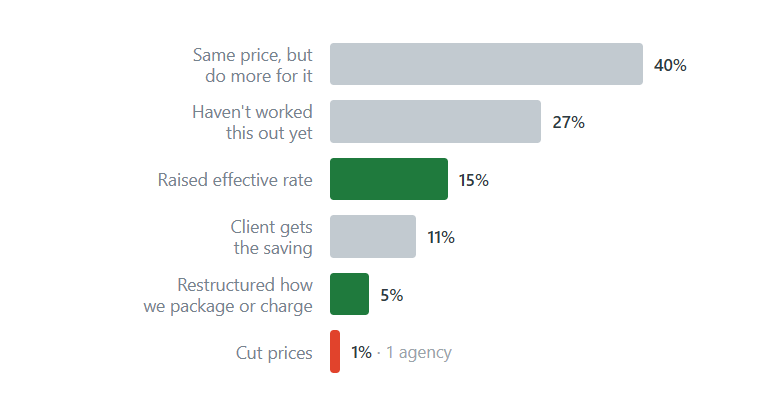
One key question, answered by 73 UK agencies, asked how the use of AI affected the price that agencies charge. The most popular answer, with over 40% of responses, was “Same price, but do more for it”.
What “we do more for it” actually means
AI has unarguably reduced the people-hours going into many types of delivery. The Agency Loop panel was reporting faster delivery thanks to AI back in May 2025, long before they started reporting better margins. That is a real saving that can only end up in one of three places:
Discuss this in the LinkedIn thread →
- Agency margin
- The client’s bill
- Back into the job as extra work for the same price
One of those options benefits the agency and two benefit the client. In fact the second and third option are two takes on the same answer: a price cut per unit of work. One survey respondent summed it up perfectly, “What we used to charge 10 days for takes 30 minutes, but we still end up doing 10 days of work for clients, just on other things.”
Sometimes that’s unintentional and the change just goes unnoticed: we are billing the same and just as busy. No one noticed the extra value. Just as often, though, it is a conscious choice. We want to do the best for clients and also know that others will do more if we don’t.
Why it feels like winning
Being fair to the 40% who have opted to deliver more for the money, it’s a valid choice. If we utilise AI better than the next agency, we can deliver more for a set budget, and that wins pitches. For some, that is the strategic choice and it chases a pay-out in the work they win and the clients they retain.
The problem is that it works for exactly as long as the next agency hasn’t done the same thing. Whatever extra we deliver this year is next year’s baseline, for us and for everyone we compete with. Once every agency is doing more for the same money, nobody has an edge and everyone has thinner margins. Clients benefit, but agencies are left in a constant race to deliver more for the money.
Clients aren’t the only ones benefiting though. There is now another party at the table, quietly enjoying a slice of everything served up: the AI vendors themselves. Subscription costs and token spend became new lines that most of us just absorbed into the P&L. Often sitting as overhead alongside our SaaS spend. Arguably justifiable whilst we all enjoy investor-backed subsidised subscriptions, but feeling more and more like a problem we are sweeping under the carpet rather than addressing.
The obvious comparison is what happened in the design world when beautiful beige Macs started landing in studios in the late ’80s. I am just about old enough to remember the “desktop publishing revolution” of my late teens. Although I was outside of the industry at the time, I was aware of the changes thanks to being a nerd who happened to be dating a graphic designer. Work was revolutionised. The bar was raised and client budgets were turned into larger volumes of great design thanks to the new technology. Studios weren’t raising fees as a result. Design has continued to accelerate ever since. The tools get faster, and the bar rises. Even the hand-written poster for the local pub quiz night now gets the design treatment.
It’s a comparison that stands in many ways, but breaks in one important one. As PageMaker was replaced by Quark, then InDesign, then Figma the software price per piece of work barely changed. More capability, but same cost filed away as overhead. Quark didn’t raise the subscription cost of every page you laid out. AI does.
The response to this is usually that tokens are cheap and getting cheaper, which is true but only part of the story and spend per job seems to be increasing. Newer models reason, loop and retry, prompting and re-prompting behind the scenes. Invisibly burning tokens to get the job done. A task that we might have spent one prompt on two years ago might burn fifty prompts’ worth of those cheaper tokens today. As the models become more capable we also involve them in more of the work. What used to be a fixed price per seat filed away as an overhead becomes a cost of sale that scales with our own ambition and is difficult to control. That might feel manageable today, but we have to remember that AI vendors are currently losing money and have huge amounts of investment that will be expected to turn a profit one day.
Pricing it in
21% of the panel have already taken the saving themselves, either raising their effective rate or by restructuring what they sell and how they charge. Still a minority, but enough to demonstrate that it can be done without sending clients packing.
That one in five have worked out that the hour was never the thing the clients were paying for. AI might have collapsed the billable hour, but it hasn’t done the same for the years of experience that go into our process or for the taste and judgement we apply using it. That was always where the value was, and it is what we now need to make the pricing describe. Hourly pricing is a nonsense when the same piece of work might take 10 minutes or 10 hours depending on who is behind the keyboard. Many agencies never priced that way in the first place, and I suspect those are the ones finding the current transition easiest.
Communicating our real value and pricing based on that is also our only real protection from the race to undercut. An agency with honed process and tooling in the hands of people who know what good looks like will continue to outperform lesser operators armed with a Claude account. Some clients have learned that lesson already, others are yet to. But it is on us to communicate that. Clients who understand the value you provide are far less likely to be tempted by headline savings.
So who is really winning right now? Clients are through the extra work we’re delivering for the same price. The vendors are through tokens. The 21% are because they priced it in. The rest of us are doing more for the same money whilst also largely ignoring one growing cost that is difficult to predict the long-term shape of.
The full Q3 report goes to the Loop panel: which agencies stayed ahead since May 2025, the pricing and margin breakdowns, how sentiment shifts with adoption, and every member’s words in full. Join the Agency Loop to get it.
Try this…
Enjoyed this article? “Try this…” is a monthly email containing one short, practical play for you to try in your agency. Sign up here →
Mat Bennett
Advisor to founder-led agencies
